
Tests Vary, Students Vary- Take Advantage!
Don’t Let the First Score Write the Story: The Case for taking the August, September, and October SATs

We have long been proponents of taking tests back-to-back, especially after intensive periods of preparation. Since most schools superscore and almost no schools (effectively just MIT and Penn State) ask for scores from all tests taken, the upside is high and the downside is close to zero. The combination of the August and October SAT combination (July/Sept/Oct for ACT) has yielded our strongest results year after year, and CollegeBoard added the September test in 2025 to provide one more opportunity in between, which is a godsend for seniors looking to improve their scores for impending college applications.

Now that we have 2 cycles of the August/September/October digital SAT stack complete, what do the numbers say?
47% of our students who prepared over the summer in 2025 or 2026 took multiple tests - 15% took it 3 times.
• Of all testers who tested multiple times, 92% finished the fall with a superscore higher than what they scored on their first attempt.
• Nearly three in four scored higher in September alone, just three weeks after August. 33% of them gained 50 points or more in those three weeks, and 10% gained 100 or more.
• Six students scored lower in September than in August and then took October. All six beat their August score in October despite the dip in September.
Take the first score with a grain of salt
The first official SAT is a different experience from any practice test. There’s an unfamiliar room, a proctor, a clock that suddenly feels real, and a lot of nerves. A first score tells you how a student did on that particular morning. It’s useful information, but it isn’t a ceiling, and students can (and often do) reach significantly higher scores shortly after.
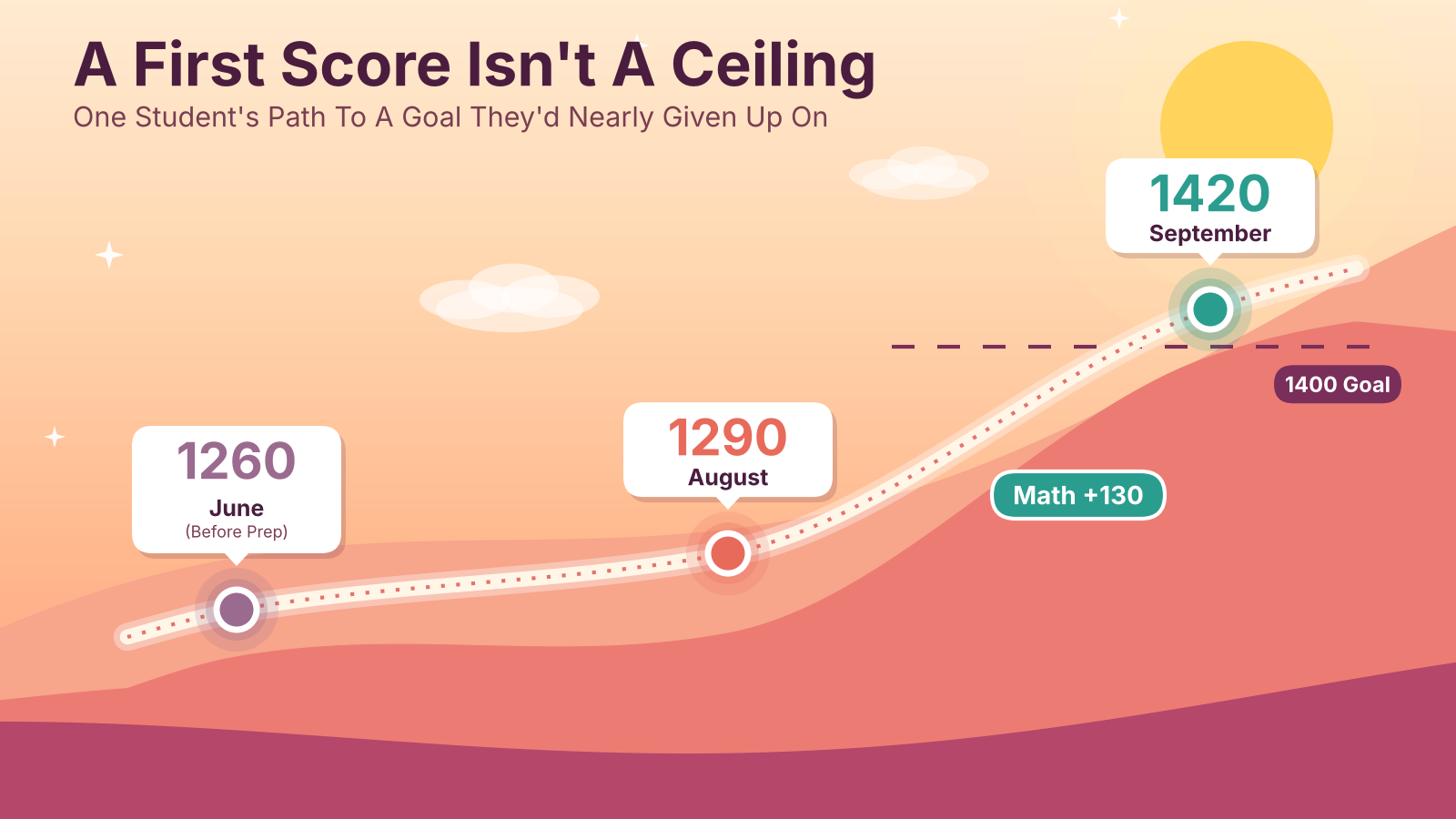
One of our students scored 1260 in June before starting with us and 1290 in August, barely moving after a summer of work. They were (understandably) disappointed enough to cancel their next session and planned on applying test-optional. They took the September test only because they were already registered and it was a week away. The Math score jumped 130 points, and they finished at 1420, above their 1400 goal. Suddenly they wanted to take October and push even higher, but by the time September scores came back, October registration had already closed.
Is it “enough time”?
The pushback we hear most is that three weeks isn’t long enough to make a real difference. If a student were starting from scratch, that would be true. But by their first tests, most of our students already know the material. Their missed questions are mostly almost correct: a misread question, second guessing a right answer, the proper setup and work with a sloppy calculation at the end.
As we covered in our post on how the SAT is scored, the test gives no partial credit. A question a student gets 90% of the way through counts exactly the same as one they left blank. That’s frustrating on test day, but it’s also why large score gains can happen so quickly. We aren’t building skills from zero. We’re turning questions that were almost there into questions that are all the way there, and on a test this tight, a few more of those per section add up quickly.
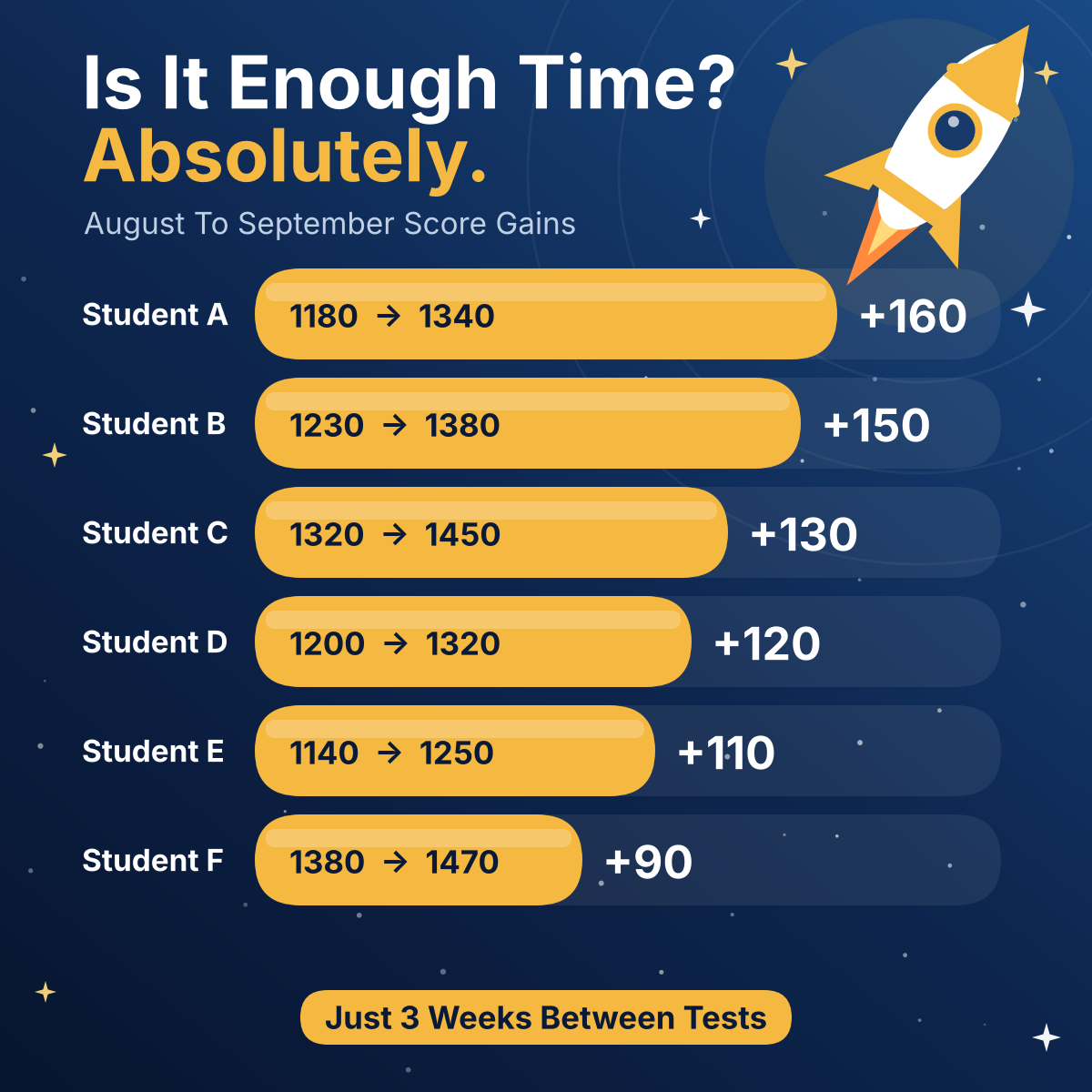
In 2026, one of our tutors had three students gain between 120 and 160 points from August to September: 1180 to 1340, 1230 to 1380, and 1200 to 1320. Another tutor had a student go from 1320 to 1450. Another had students going from 1140 to 1250 and 1380 to 1470. None of these students learned anything groundbreaking in those three weeks. They cleaned up the execution on what they already knew.
A September dip isn’t the end, either
Sometimes the second test goes the wrong way, and that can feel even worse than a disappointing first score. One student opened with a strong 1500 in August, then scored a 1440 in September. In October, they secured a 790 in Math for a 1540 superscore. Mission accomplished.
This isn’t a one-off, either. A 2025 student went from 1310 in August to 1250 in September before scoring a 1420 in October. A third went 1480, 1410, then 1520. In all six cases in which a student dipped in September but then tested again in October, the October score finished above the August score.
Superscoring rewards every attempt
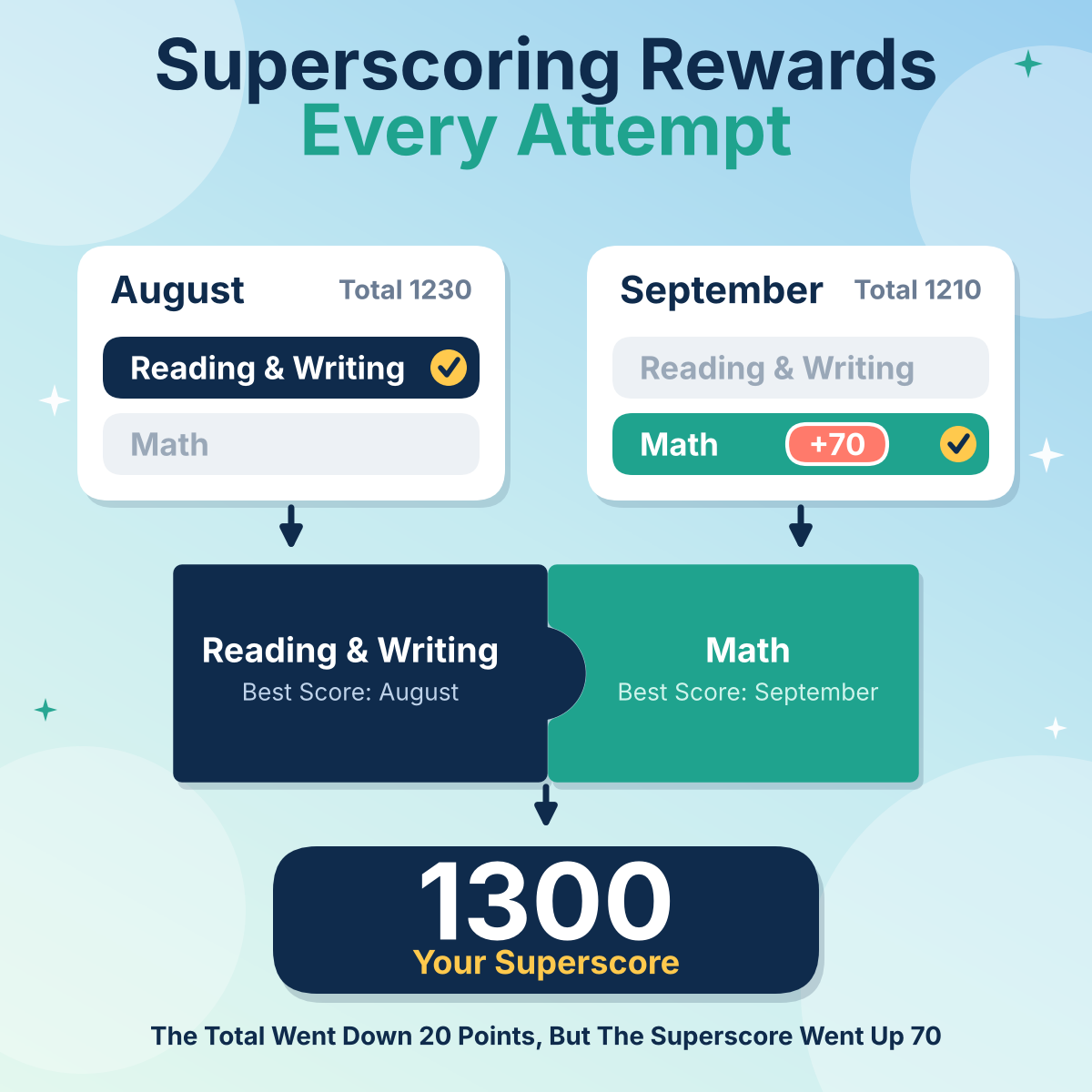
Many colleges superscore, combining a student’s best Reading and Writing score with their best Math score across test dates. That means a lower overall score can still help.
One student scored a 1230 in August and a 1210 in September, which looks like a step backward. But this was unsurprising- we knew there math would have more room to gain than Reading/Writing, and had shifted focus accordingly. The Math rose 70 points in September and the superscore came out to 1300, which is exactly what this student had been hoping for.
Plan for all three before August
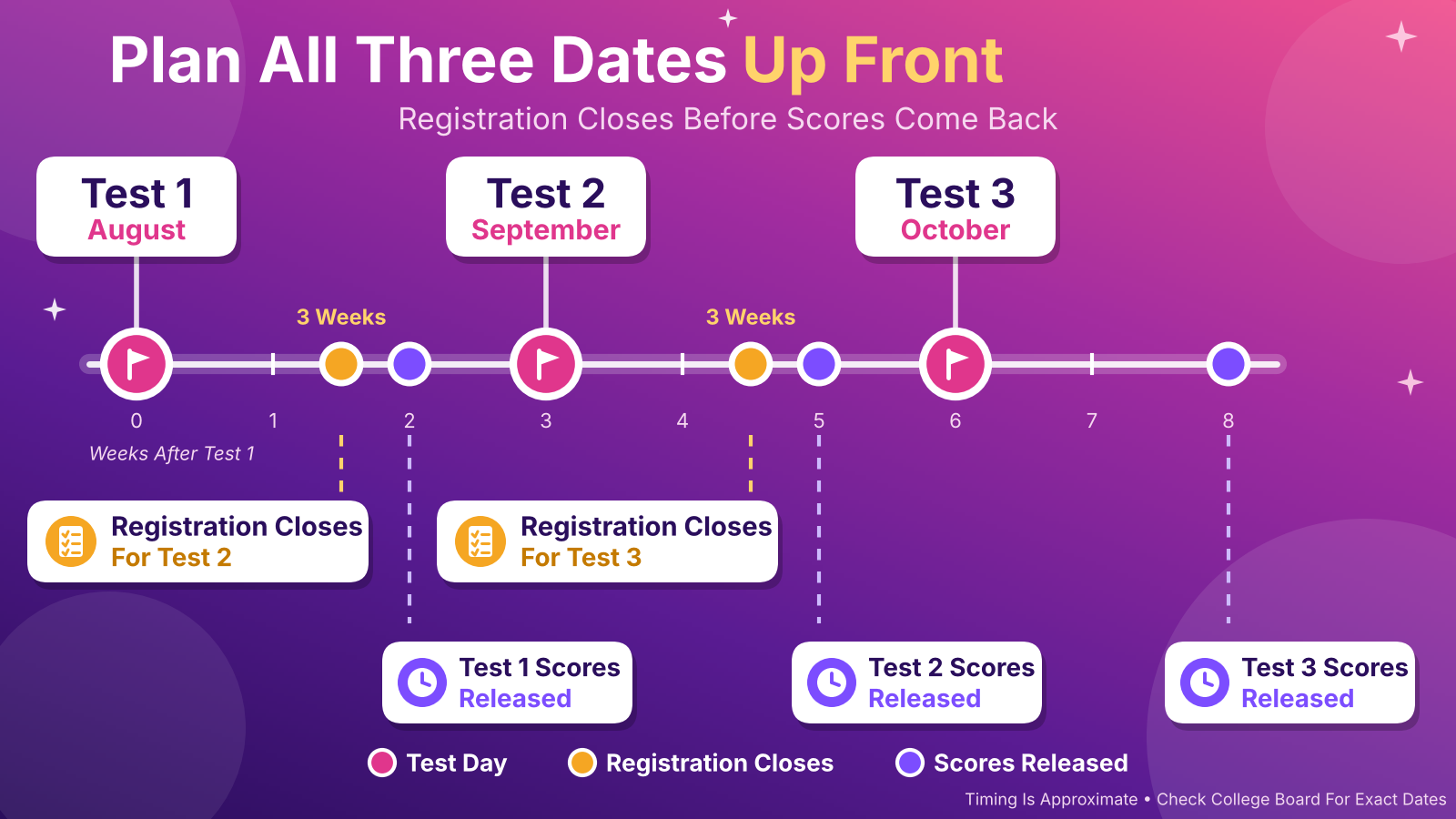
The calendar is the part families most often underestimate. The fall tests are three weeks apart, and scores take roughly two weeks to come back. Registration for the next test usually closes before scores from the previous one are released. In other words, you won’t have a score in hand when it’s time to decide about the next date.
Register for all three dates up front. In the grand scheme of things, an unused registration costs far less than a missed test date you end up regretting.
Keep preparing straight through. The timelines are tight and the margins are slim- carefully identify the areas that are “close” and *also* be intentional about question types that can/should potentially be navigated around. The biggest “weaknesses” may not necessarily be the areas that should be invested in.
Talk to your tutor before deciding anything. We review every official score and can usually tell you exactly where the points went and what practical next steps should be.
Close doesn’t count, until it does
We tell students all the time that being close doesn’t count. But close is exactly where most students are after August, and August, September, and October give them three chances in six weeks to finish the job, while their prep is as fresh as it will ever be and school hasn’t become overwhelming. For seniors, these attempts all yield scores before almost all early application deadlines, most of which are in November. Most schools with earlier deadlines (such as UNC, UF, UGA, and UT Austin), have October 15th application deadlines with separate (later) materials deadlines to send scores by. For a few more weeks of effort, the opportunity to improve admissions and merit outcomes is tremendous!