
A “Timing” Problem Isn't Usually a Timing Problem
Ask a student what went wrong on a test and you'll hear the same four words more than any others:
I ran out of time.
It's one of the most common self-diagnoses in test prep, but timing is rarely the disease. It’s the symptom of something more specific underneath.
Finishing Isn't The Goal
Standardized tests aren’t graded for completion.
A student who answers all 45 ACT math questions with four minutes to spare and misses 14 of them scored worse than a student who guessed on the last six and missed 8. The second student “had a timing problem.” The first one didn't, but they have the lower score.
A student who believes they're too slow speeds up. And speeding up means skimming the prompt, skipping the setup, and/or making “careless” errors.
When a student genuinely does run short, there are usually two culprits.
Starting Before Planning.
The student reads a question and immediately starts doing something - throwing everything into Desmos, plugging numbers into answer choices, underlining everything in the passage - before deciding what the question actually requires. Forty seconds later, they're completely lost in the answer choices, have scrambled, directionless work on their paper, or have to re-read the entire text from the start because they didn’t understand it from a quick skim. Fifteen seconds of intentional thinking at the front end would have saved ninety at the back. The first step is generally the most difficult and important step. If a student doesn’t feel confident about any question after 10-15 seconds of analysis and planning, they should move on- not just jump into action and hoping they figure it out along the way.
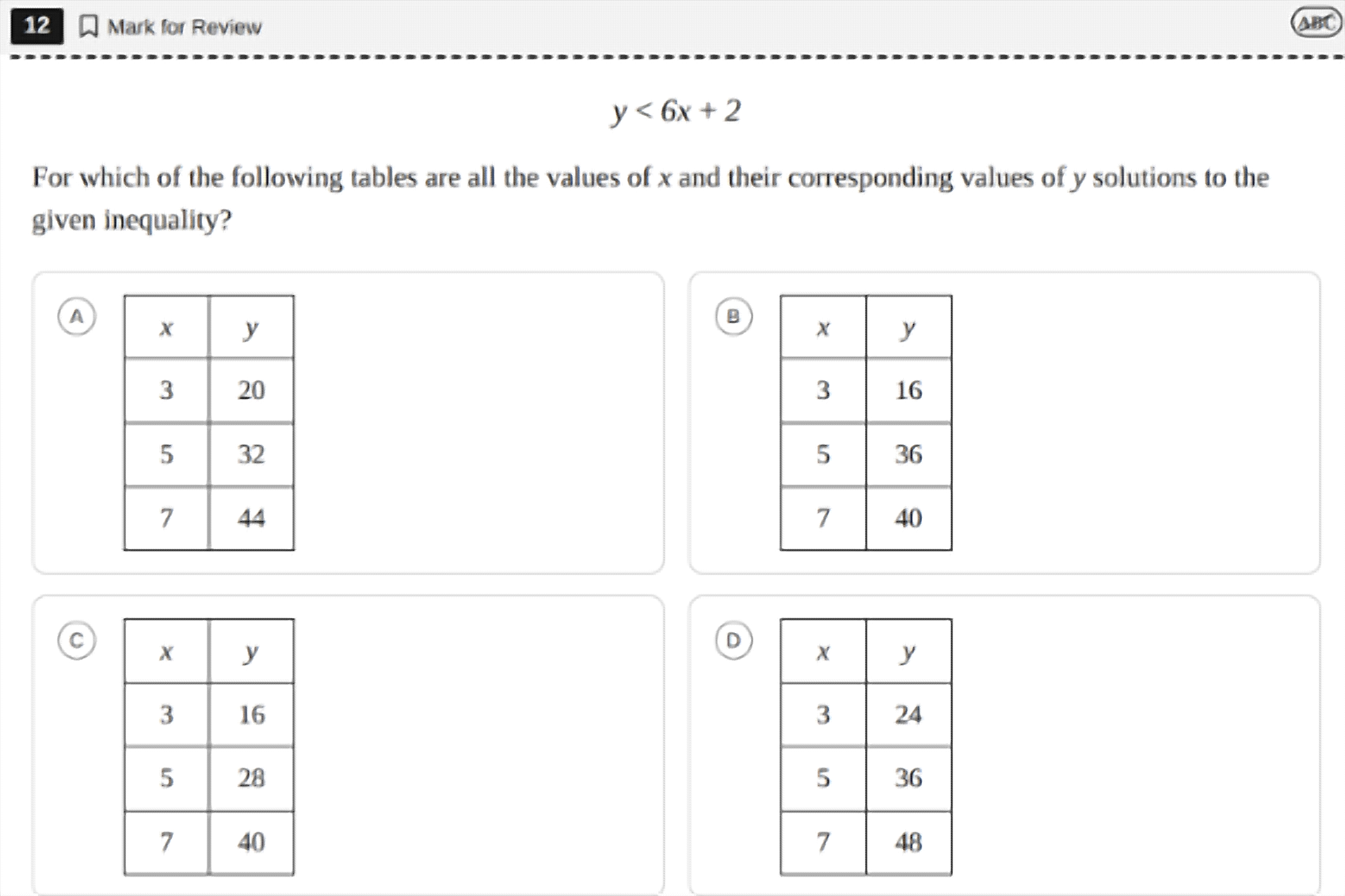
Here’s a great example. Students see that y is less than 6x+2. Perhaps they begin testing each table, plugging in the value of x to verify that the result is greater than the corresponding value of y. Maybe they go to the “cheat-code” Desmos Graphing calculator to graph and visually examine the options.
But if they took a few seconds to think, they would recognize that all of the answer choices have the same x values. And we are looking for a y value that is *less than* 6x+2. So, we could simply choose the answer that has the lowest y values - option C. This “math question” required no math. It can be answered in less than 10 seconds with some critical thinking.
Unrecognized Content Gaps.
A student who knows a rule or recognizes a question format executes immediately. By the time our students are testing, we do not expect them to be doing much “thinking” or “figuring out” on most questions. They should be reacting to patterns and triggers that are deeply entrenched, just like a professional golfer isn’t thinking about every detail of their swing every time they go through the motion.
We carefully track time spent per question on practice sets, as oftentimes questions that were answered correctly could have (and should have) been completed more quickly with different knowledge, tools, or processes.
Know Where The Points Are
Understanding the nuances of test construction and scoring can help us navigate them better.
Math runs easy to hard.

On the ACT, the questions get harder, but they’re not worth more. A student who is worried about time often makes several errors rushing past attainable points (doing sloppy mental math “to save time” or not fully reading questions) towards questions that will take more time and be more difficult to answer correctly. They’ll brush the “silly mistakes” off, insisting they know how to do them, and ask to focus on “hard questions.” Securing the early and middle questions carefully - even if that means guessing on the last several - is almost always the better trade. SAT scoring is more complex and questions are weighed differently, but the principle of carefully securing attainable points generally produces stronger scores as well.
SAT Reading/Writing ALWAYS groups questions by type
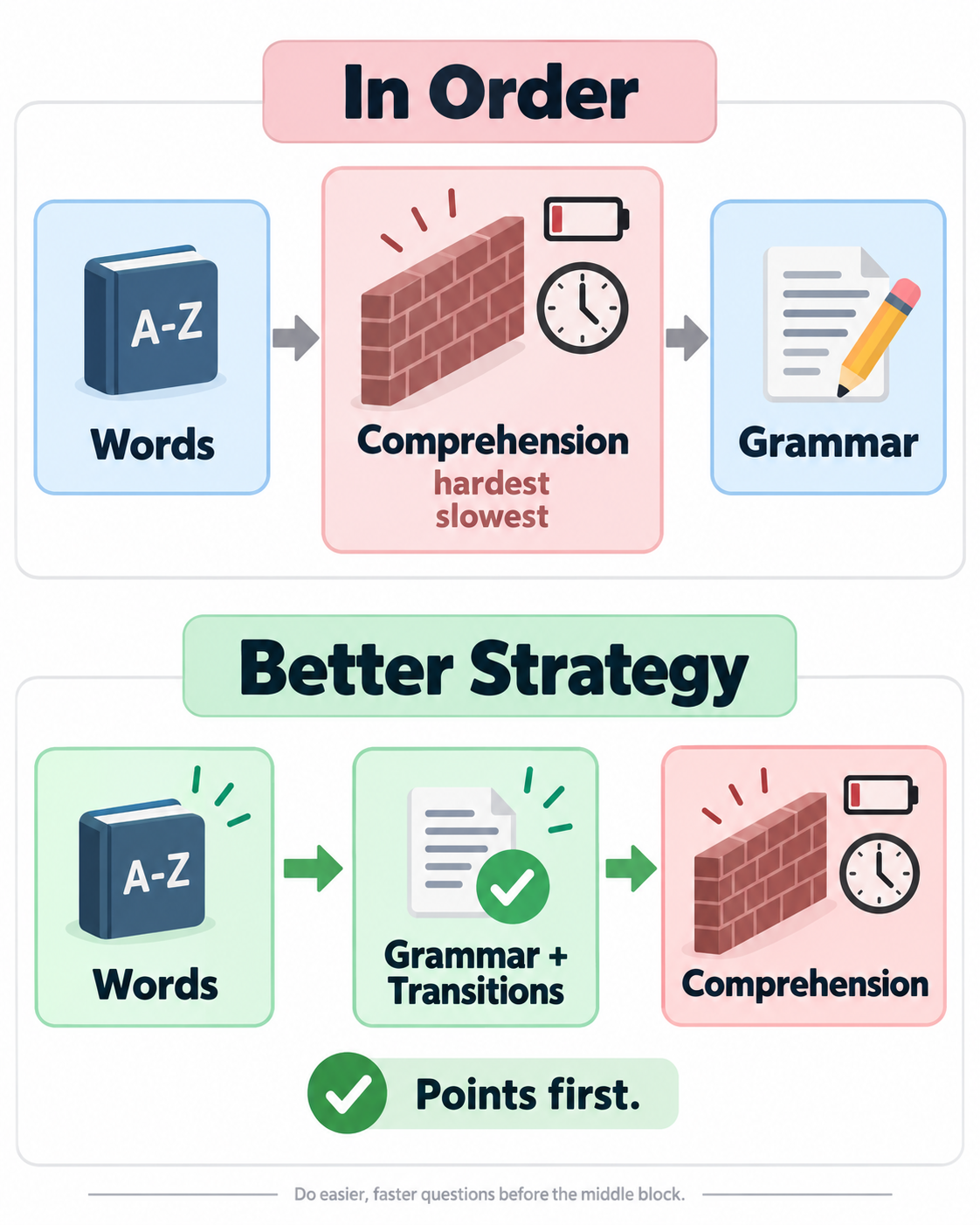
Every module opens with words-in-context questions, moves into the denser “comprehension block” – main idea/purpose, command of evidence, inference - before arriving at grammar.
That middle block is the wall. It has the longest passages, trickiest answer choices, and takes the most time per question. The grammar section that follows it is, for most students, considerably faster and more formulaic.
A student working strictly in order spends most of their attention and time on the hardest questions, then scrambles through the end.
This is why we have students do the words-in-context questions, then jump ahead to the grammar and transitions questions, and only then come back to the comprehension block in the middle. If they run out of time, they’ve secured as many points as possible before then.
You Can Miss More Than You Think
None of this works for a student who believes they need to shoot for perfection. It’s like swinging for a home run when a double wins the game. Students must strategically and methodically choose and secure the points that will lead to the specific results they want.
Here are some excellent case studies from our students on official CollegeBoard BlueBook practice tests.
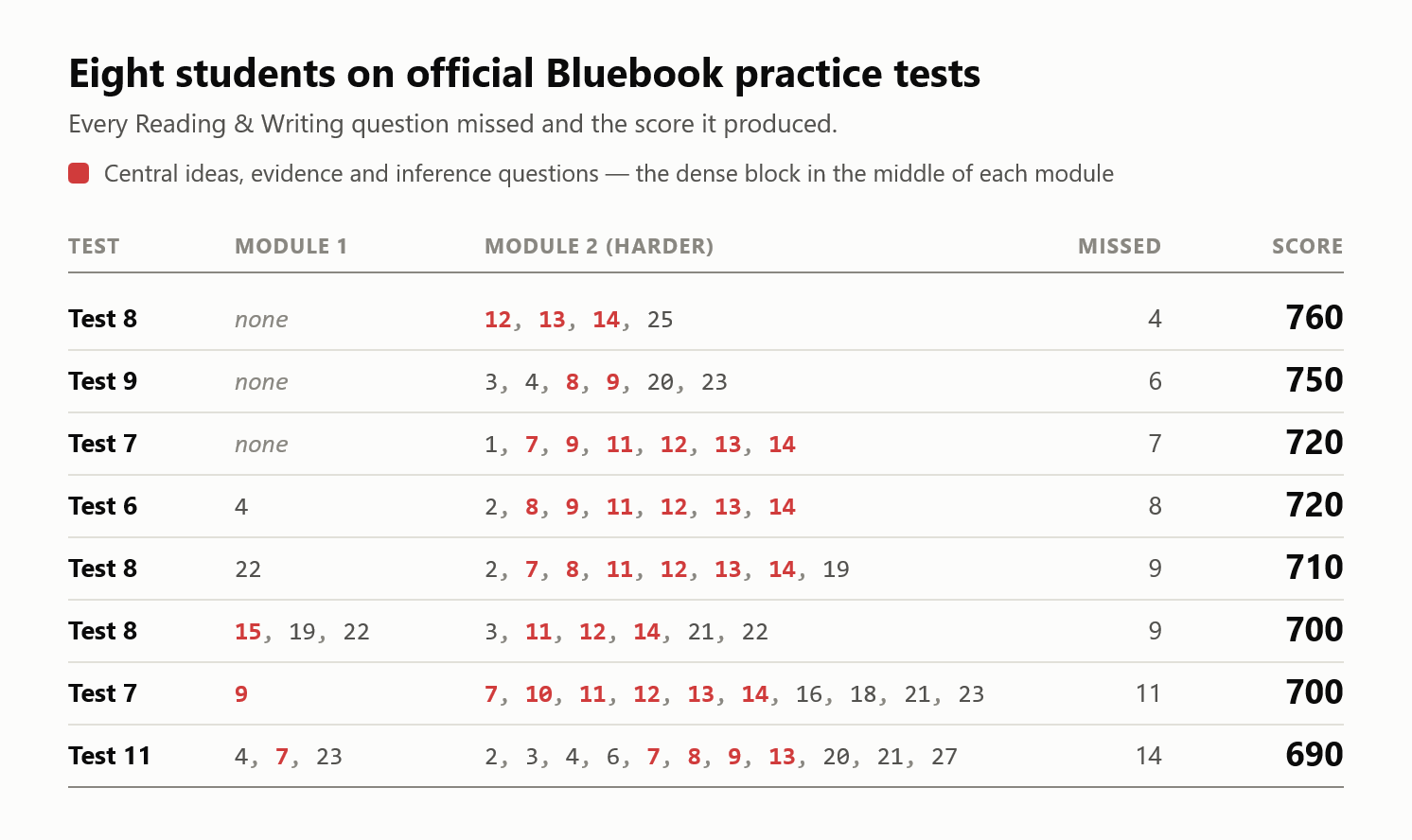
Students must be methodical in Module 1. Minimizing errors on the “easier” of the two modules (if we are shooting for a 700+ type score) is crucial. However, there is some flexibility on Module 2- notice the results of Test 9 (row 2). This student scored a 750 Reading/Writing while missing nearly a quarter of the second module! The more time-consuming “reading comprehension” questions are marked in red- the pattern of missing questions in the 7-15 range is the result of students deliberately choosing to prioritize points they felt they could obtain more confidently and quickly in other areas of the test.
ACT math tells the same story on a fixed scale. Across the official practice tests in the current prep guide, a 30 requires 33 or 34 correct out of the 41 that count. Seven or eight can be missed. A 27 allows ten or eleven. A 24 allows fifteen or sixteen.
The Reframe

If your student says they have a timing problem, the answer isn’t “go faster.” In fact, obtaining a higher score likely necessitates *going slower. * Choosing intention over speed and moving with confidence (with an understanding of how the tests are scored) instead of panic leads to better outcomes.