
Standardized Test Scoring

Standardized test scoring (and really so much about the tests in general) can be confusing. Deciphering scores and score reports is not intuitive.
This confusion and the natural desire to make sense of it all leads to all types of misconceptions and myths. It's also why the notion of “being a good or bad ‘test taker’ exists.”
But think about it- your student takes tests constantly. Unit tests, midterms, finals, quizzes, lab practicals, in-class essays… a typical high schooler sits for several timed graded assessment almost every week of the school year. Whatever is happening on the SAT or ACT, "bad test-taker" probably isn't it.
Here are the three differences that matter most.
1. School tests one concept at a time. Standardized tests don't tell you what they're testing.
Think about how a school math test gets built. There's a unit on systems of equations that runs two weeks. At the end of it, there's a test on systems of equations. Your student walks in knowing exactly what to expect and can reasonably memorize the exact steps they need to take on the test.
That's a reasonable way to teach and build core skills and content knowledge. It’s also why many schools offer re-takes and test-corrections.
However, on a standardized test, question 12 doesn't announce itself. It's a paragraph about a landscaping company with a fixed delivery fee, and the first job - before any actual math happens - is to recognize this is a linear relationship, and I'm being asked about the slope. The topics are interleaved deliberately: a geometry question, then a ratio question, then an exponential function, with no headings or unit at the top of the page.
That recognition step is the skill. This is “critical thinking.” It isn't a personality trait or a knack. It's pattern recognition, and it gets built the same way any other skill gets built - through repeated exposure and consistent execution. Many students will look at a question and give us an “I don’t know” the second they run into the slightest bit of resistance. But the first step will often reveal information and details that lead to the second step and on from there. It’s a full problem-solving *process,* and the questions often aren’t going to be conquered in one step with one look. We teach students to treat SAT/ACT math questions more like physics questions than the version of math they are used to in school. Physics questions are often dense and can be overwhelming with information and possible formulas to use and steps to take. The setup is the most important part.
2. Close counts in school. Not here.
Here is an actual test question. It is missed by *tons* of students, and it’s not exactly “hard.”
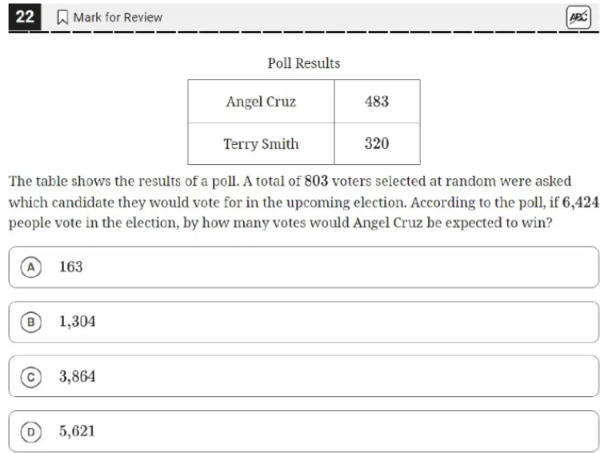
This question tests a proportional relationship. Most students choose C. 3864 is the number of votes Angel Cruz would expect to receive. They select it confidently, positive they got the question correct. In fact, they haven’t done anything necessarily *incorrectly.* They stop one step short of the actual question and find their number waiting for them in the options. The question asks how many votes Angel Cruz is expected to win *by.* Not how many votes he is expected to win.
In a classroom, this error would earn 4 out of 5 points and a note in the margin: careful! The teacher can see the whole chain of reasoning on the page and grades what the student actually knew. On the SAT, it’s worth the same as looking at it and leaving it blank. Zero. Students will insist “I knew how to do it!” or “I’ll be more careful!” And then the errors persist- because students are not used to feeling meaningful consequences for being “close.”
The same thing happens when a student solves for x and the question asked for 2x or y, finds the perimeter when asked for the area, or answers in feet when the question specified inches. In every case, the student knew the math completely, felt confident, and the score doesn't reflect that at all.
This is why we add one step to every math question: before solving, write the “ask” on the scratch paper - "by how much?" or "area" or "inches" - and check the final answer against it. It takes about three seconds. Error prevention is just as important, if not more important in many cases, than “knowing the content.” Recognizing the seriousness of these “silly mistakes” and being dedicated to incorporating actionable steps that prevent such slips are key differentiators of highly successful students.
3. Because there's no partial credit, small changes move scores significantly.
On a standardized test, a great many missed questions aren't knowledge failures at all. They're process failures and misunderstandings of the scoring of the test: answered the wrong quantity, misread a "NOT" in the prompt, ran out of time on question 20 after over-investing in question 6, picked the choice that was true but didn't answer the question. Students are also hard-wired to “finish” tests and worry so much about time- the idea of running out of time on a school test is incomprehensible, and being coached to prioritize in-depth accuracy even at the expense of a handful of questions feels blasphemous. But getting 80% there on 10 questions counts as 0. We’ll take 100% on 8 questions and sacrifice two any day. Students can get a quarter to a third of the harder reading module 2 on the SAT incorrect and still score 700+! On a school test, a 66% would probably feel devastating- not like a top 8% performance.
Many are errors fixable by a few impactful behavioral tweaks- not wholesale overhauls. That's why scores can jump in ways that look implausible from the outside. We can see scores swing as much as 150 points from test to test. A student didn't suddenly get better at algebra or learn how to read. They stopped losing four or five questions per section to preventable process errors or went in with a different mentality, perhaps willing to move on from timesink questions or avoid particular types of reading passages and invest time more effectively in more impactful areas.
The flip side is also true: a student who never addresses these habits can study for months and watch the score sit still. The processes and habits that lead to strong grades in school can be an anchor on standardized test scores if adjustments aren’t made. We don’t stop a bad habit by trying to stop it. We must replace it with a better one. These problemsolving and critical thinking skills can indeed be learned and mastered with intention and effort, but first, we must fully understand what the process entails and understand exactly what must happen to get from where we are at to where we want to be.
A Note on Score Reports
On the topic of scores, information, and identification of growth areas, it’s also worth mentioning the score reports CollegeBoard in particular puts out. While at the surface, they may *look* useful, we do take them with a grain of salt. Again, there’s no partial credit on the SAT, and anything that was 99% correct is viewed as entirely wrong. There is also no consideration of timing factors- sometimes, a student may appear “weak” in a certain area not because they don’t know the material, but because certain questions they didn’t get to just happened to be testing those skills and they did not have the opportunity to demonstrate their knowledge.
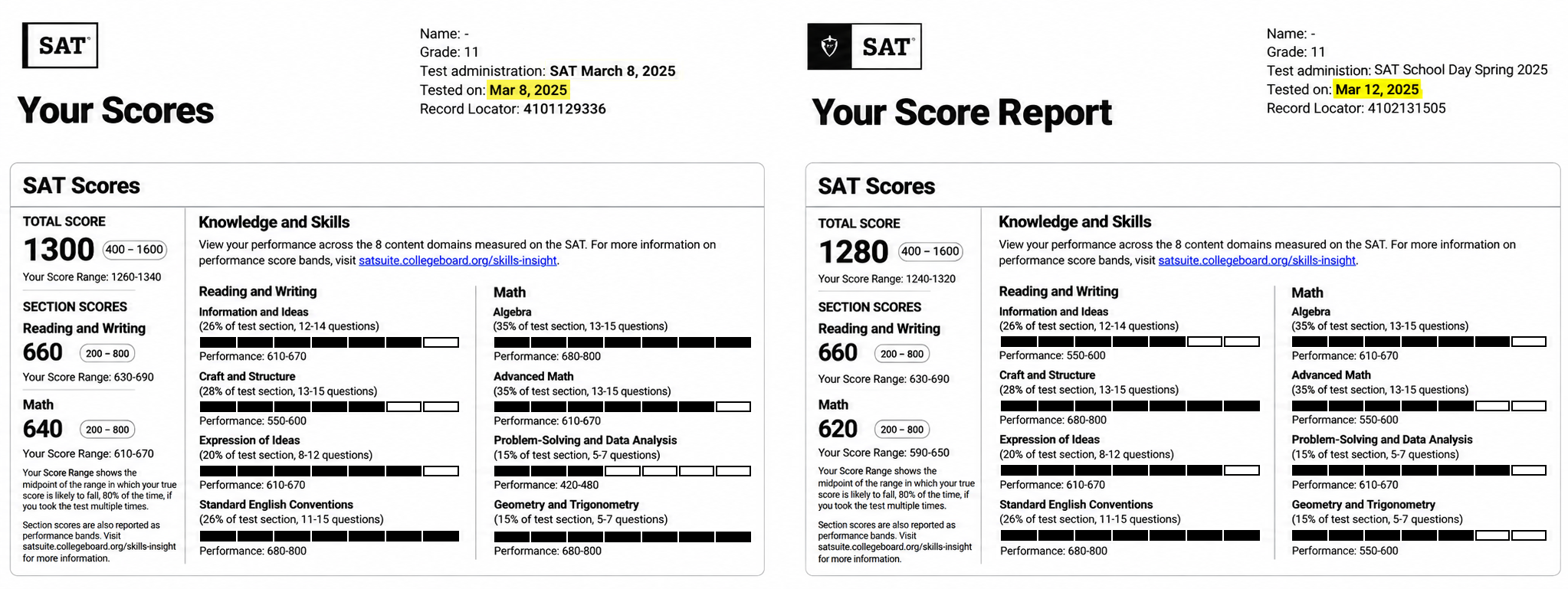
Here are the score reports of a student who took two official CollegeBoard tests 4 days apart. It’s not like the student mastered “craft and structure” and “problemsolving and data” over those four days. Concurrently, they likely didn’t “get worse” at Information and Ideas, Algebra, Advanced Math, and Geometry. The devil lies in the details, which is why we prefer working from official practice tests rather than actual tests and score reports. Practice tests afford us the opportunity to actually review a student’s work and discuss specific questions with them. These score reports don't provide the full story and can be easy to overreact to!